
Why Movement Makes Sense ?
As a young man with Dyslexia, comfort within the classroom always seemed somewhat allusive. While the information being delivered always intrigued me, the pedagogical approach to its delivery presented frictional barriers I was yet to understand. These barriers cultivated a persistent notion that all acquisition of information would require; extra effort, resilience to discomfort and individualised coping mechanisms.
Such a relationship with academia was difficult, but allowed me the autonomy to explore and develop means of “keeping up” with peers, all while building other reward systems. One such reward system was sport. Where reading and comprehension presented challenge, touch, movement and physical articulation gave clarity. Where spelling, grammar and punctuation seemed nonsensical, technical and tactical skills of sport presented rewarding challenge.
With sport as a safe means of reward and challenge, I often saw its potential to synergise learning within the environment of academia as deeply promising. These thoughts matured into questions: how can movement support understanding? where is movement most applicable to information acquisition and retention? What impact does physical articulation play on information processing?
These queries and questions culminate at the point of growing demand for innovative Pedagogy. With increased adolescent diagnoses of neurodivergence and growing evidence for the utilisation of physical activity for benefits in neurodivergent youth, the utilisation of movement and play for the acquisition of language presents promise.
5-12%
Population with Dyslexia in Europe.
1 in 127
Individuals with autism Spectrum disorder.
18 Studies
Successful interventions using physical activity in neurodivergent children.
- Dyslexia preverlance and diagnostic variation across europe (Report). Erasmus = Programme. Dyslexia Compass Report
- Tao, X., Li, Y., Chen, M., & Zhang, L. (2025). Effects of physical activity on cognitive function in neurodivergent youth: A meta-analysis. International Journal of Behavioral Nutrition and Physical Activity. https://doi.org/10.1186/s12966-024-01702-7
- World Health Organization. (2025). WHO statement on autism-related issues. https://www.who.int/news/item/24-09-2025-who-statement-on-autism-related-issues
Why Language Learning and Movement
Movement Meets Meaning
The combination of privileged opportunities and an over compensatory desire to “prove oneself”, has granted me the chance to traverse nine different nations. With integration an ever present thought, language became both the preliminary step and deeper gateway into the host nation culture. With my internalised worries of competencies in my native tongue, learning additional languages seemed somewhat of an impossible task.
Although intimidating, I knew that learning, at least a functional level of the local language, would allow me access to social groups and opportunities I would otherwise not have access to. To achieve this, I used the tools I had access to and the reward systems I cherished. Basketball, my professional environment at the time of entering Spain, presented an opportunity to learn the language while in a comfortable and familiar environment. As time passed, I began to notice that my recollection of given words became associated with given actions and gestures. This familiar environment of sport empowered me to practice and make mistakes in ways a classroom never could.
With the growing momentum of vocabulary, I began to recognise new environments I could now enter with confidence and new opportunities that arose as a result. Such opportunities prompted introspection and enabled me to highlight the transition from language insecurity to empowered, functional fluency.
Gateway to Belonging
Language provides a key to social integration and facilitates access to community, identity, opportunities and self efficacy.
Memory Anchor
Movement and play have the ability to enhances vocabulary retention and increase learner engagement.
Inclusive Pedagogy
Language learning, in social emotional learning environments such as sport, can support neurodivergent learners.
- Pasquarella, A., Jia, F., Ferreira, A., & Schwieter, J. W. (2025). Culture and second language (L2) learning in migrants. Frontiers in Psychology, 16. https://doi.org/10.3389/fpsyg.2025.1586832
- Ortiz Calvo, A. (2013, January). El valor de la Educación Física en la enseñanza del Inglés como lengua extranjera. EFDeportes.com, Revista Digital, 17(176). El valor de la Educación Física en la enseñanza del Inglés como lengua extranjera
- Panwar, M., & Lata, P. (2025). Empowering neurodivergent learners in inclusive classrooms: A culturally responsive teaching (CRT) perspective. PUPIL: International Journal of Teaching, Education and Learning, 9(1), 41–58. https://doi.org/10.20319/pijtel.2025.91.4158
How the Body is a Learning Tool
The Theoretical Framing & Conceptual Evolution
One way in which the body can be used to aid learning is the Kinaesthetic Learning model. This specific model is the practice of learning through movement and physical experience.
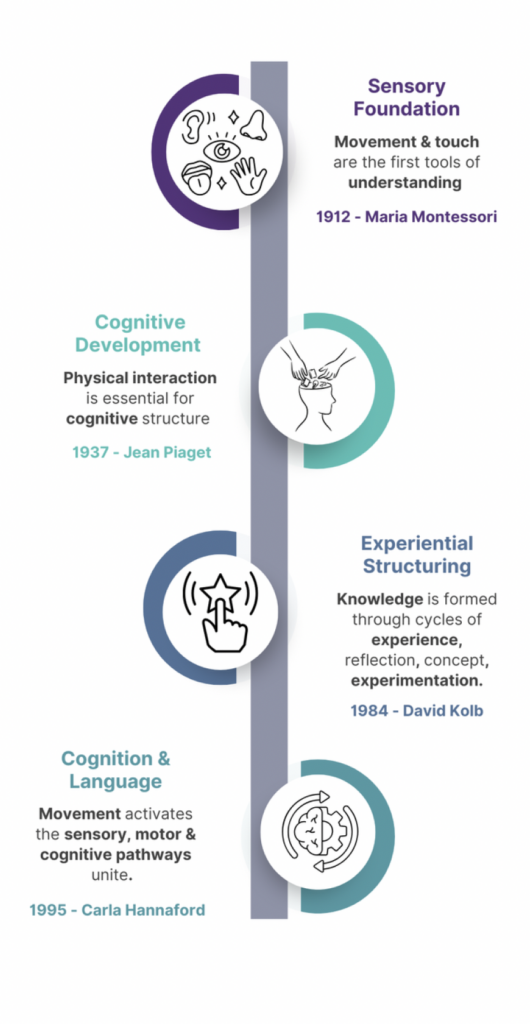
As early as 1912, Maria Montessori championed such a model highlighting its hands-on exploration for deeper understanding and scalable growth. Maria’s early exploration of the model highlights the body as the centerpiece of learning where elements such as touch and active engagement sharpen cognitive development.
Decades later, Jean Piaget expanded such a model through a four stage theory of adolescent cognition. This model placed movement, in the sensorimotor stage, as a necessity for cognitive development and highlighted physical interaction with the external environment as a force amplifier for mental growth. These developments laid the psychological foundations of the kinaesthetic learning and expanded Montessori’s recognition of constructivist learning.
In the 1980’s, David Kolb introduced experiential learning theory, developing a 4 stage learning process. His findings, from concrete experience to active experimentation, present our step towards structured movement and play environments. This is reflected in how the learners embody the concepts before abstracting them, moving kinaesthetic learning from cognitive to include conceptual.
More recently, Carla Hannaford’s smart moves presents movement not only as a beneficial aspect to learning specific information, but an essential one. where sensory, motor and cognitive systems of movement can be utilised for the acquisition of complex information such as language. This marks the transition of Kinaesthetic methods of learning to be used as a specific tool for language acquisition.
- Montessori, M. (1912). A critical consideration of the new pedagogy in its relation to modern science. https://doi.org/10.1037/13054-001
- Piaget, J. (2013). The construction of reality in the child. Routledge. https://doi.org/10.4324/9781315009650
- Kolb, D. A. (2014). Experiential learning: Experience as the source of learning and development. FT press. Experiential Learning: Experience as the Source of Learning and Development – David A. Kolb – Google Books
- Hannaford, C. (1995). Smart moves: Why learning is not all in your head. Great Ocean Publishers, Inc., 1823 N. Lincoln St., Arlington. https://eric.ed.gov/?id=ED389103
Can Movement Become a Language Classroom?
Where Movement Meets Method
There are two clear theoretical applications of kinaesthetic learning for language acquisition: Total Physical Response and Gestures. While I was lucky enough to have experienced both, further understandings of these practices supports easier replication and aids pedagogical validity.
Total Physical Response (TPR)
TPR is a method of teaching language that mirrors how children learn their first language. It pairs a given verbal input with a physical movement. TPR utilises a 3 stage method:
-
Verbal Input – a simple command is spoken, offering the learner a clear vocal input.
-
Physical Response – The learner then performs the action, associating meaning with movement.
-
Active Production – over time, the learner begins to verbalise the command themselves, transitioning from passive association to active vocabulary use.
What highlights TPR as a powerful practice is its ability to reduce elements of cognitive overload and lowers levels of anxiety in its learners, allowing for a reduced fear of failure. This reduction in fear of failure is especially empowering for neurodivergent learners.
Verbal Input
Teacher / coach provides command in second languange (e.g. Dribble).
Step 01
Physical Response
Learners perform the action, associating movement with the meaning.
Step 02
Active Production
Learners begin to use the terms themselves, responding to vocabulary and instructing peers.
Step 03
Gestures
Gestures are our non-verbal scaffolding of language acquisition. Gestures activate multiple areas of the brain involved in memory and language processing. As a gesture physically embodies a meaning, a multisensory pathway is created to reinforce vocabulary and comprehension.
Gestures are the universal language that are adaptable across contexts and transcend linguistic barriers. This transcendence lowers the barrier for entry, making gesture based language acquisition more accessible to Neurodivergent learners. This practice therefore offers its learners a platform for linguistic acquisition that is both inclusive and effective.
Initial Gesture
Teacher / coach gestures "shoot" while verbalising the action.
Step 01
Mimic
Learners mimic the gesture or perform the action as prompted.
Step 02
Mnemonic Device
Gestures becomes a mnemonic device that helps the learner recall vocabulary.
Step 03
The combination of privileged opportunities and an over compensatory desire to “prove oneself”, has granted me the chance to traverse nine different nations. With integration an ever present thought, language became both the preliminary step and deeper gateway into the host nation culture. With my internalised worries of competencies in my native tongue, learning additional languages seemed somewhat of an impossible task.
Although intimidating, I knew that learning, at least a functional level of the local language, would allow me access to social groups and opportunities I would otherwise not have access to. To achieve this, I used the tools I had access to and the reward systems I cherished. Basketball, my professional environment at the time of entering Spain, presented an opportunity to learn the language while in a comfortable and familiar environment. As time passed, I began to notice that my recollection of given words became associated with given actions and gestures. This familiar environment of sport empowered me to practice and make mistakes in ways a classroom never could.
With the growing momentum of vocabulary, I began to recognise new environments I could now enter with confidence and new opportunities that arose as a result. Such opportunities prompted introspection and enabled me to highlight the transition from language insecurity to empowered, functional fluency.
- Asher, J. J. (1966). The learning strategy of the total physical response: A review. Modern Language Journal, 50(2), 79–84. Total Physical Response
- Pramesti, K. N. F. (2021). The Implementation of Total Physical Response in English Learning for Attention Deficit Hyperactivity Disorder Students. Journal of Educational Study, 1(3), 172–181. https://doi.org/10.36663/joes.v1i3.184
- Willems, R. M., et al. (2007). When language meets action: The neural integration of gesture and speech. Cerebral Cortex, 17(10), 2322–2333. https://doi.org/10.1093/cercor/bhl141
How the Body is a Learning Tool
The Theoretical Framing & Conceptual Evolution
As we seek a more inclusive and engaging environment for neurodivergent learners, alternative pedagogical approaches presented by movement and play remain compelling. Where my personal discomfort in the traditional classroom setting was prominent, movement and sport gave me access not only to vocabulary, but to belonging.
Dyslexia, as well as other neurodivergence, often create friction with traditional educational structures and language systems. Pedagogical innovations, like the use of a sporting environment for language acquisition, present the transformative power to build confidence and community in a once intimidating task.
We now understand that physical articulation and movement are means of reducing cognitive load when learning. When presented in the format of gestures, memory and comprehension are reinforced. When presented in the format of TPR, empowerment of neurodivergent learners occurs. When these factors converge in a sporting environment, there is great inclusive potential for embodied learning to reform the neurodivergent relationship with language and language learning.
What We Know Now?
If we want language learning, and at the macro level academia, to be more inclusive we must let every body speak.
The incorporation of TPR and gestures into bilingual sports programmes will elevate all learners ability acquire language.
The elaboration of existing inclusive curricula for neurodivergent to incorporate movement and play as means to learn, will amplify its ability to achieve its objectives.
Ensuring that our educators are themselves educated on the use of movement as a pedagogical tool, will allow its benefits to reach a widespread audience.
All methods would empower those to access a skill that traditional infrastructure makes difficult to attain.
Where do we go from here?
Movement, play, sport, bring with them a complex set of tools. These tools, when given the pedagogical framing, empower those that feel disenfranchised by an educational system that lacks the malleability to include.
Language is not simply spoken, it is felt, it is moved and most importantly lived. Let’s position sport as our universal language, so that all may be granted access to the opportunities that education provides.
- Sintawati, F. (2023). The implementation of total physical response (TPR) method towards english language learning on autism student at al-khairiyah school for special children (slb) cilegon. JIPIS, 32(1), 1-7. https://doi.org/10.33592/jipis.v32i1.3287
- Le Cunff, A. (2024). Neurodiversity-Informed Investigation of Psychological Experiences and Neurophysiological Correlates of Cognitive Load in Online Learning. King’s College London. Neurodiversity & Cognitive Load
- Iverson, J. M., & Goldin-Meadow, S. (2005) Gesture paves the way for language development. Psychological Science, 16(5), 367-371. https://doi.org/10.1111/j.0956-7976.2005.01542.x
- Kinjo, M., Mori, K., & Tanaka, A. (2016). The performance verification of foreign language activity using TPR for the elementary students with intellectual disabilities. Asian Journal of Human Services, 10, 68-82. https://doi.org/10.14391/ajhs.10.68